The 528 Hz Tone Generator: Engineering Clarity, Communication, and the "Miracle" Frequency
Let’s cut through the metaphysical fog for a moment. You didn't land here by accident. You either felt a deep resonance with the concept of the "Love Frequency," or you are chasing a specific acoustic result: pure, unadulterated clarity. In my decades of clinical and acoustic work, 528 Hz occupies a fascinating niche. It sits right in the heart of the human voice, and acoustically, it is a powerhouse for auditory precision. This generator is not just about healing vibes; it is about sonic focus. Let me show you how to wield this specific pitch for maximum effect, both physically and perceptually.
Why This Specific Pitch? The Real Problem 528 Hz Solves
When a client walks into my clinic asking for 528 Hz, they usually aren’t just asking for a "nice sound." They are searching for a solution to a feeling of mental static, or they are trying to establish a profound sense of environmental order. The specific problem 528 Hz solves is auditory masking—the inability to distinguish signal from noise in your internal or external environment.
Because 528 Hz falls squarely within the midrange band (250 Hz – 2 kHz), it directly engages the resonant frequencies of the human cochlea where we process speech and complex harmonics. It acts as a "carrier wave" for attention. When you generate this tone, you are not adding bass rumble or high-end sizzle; you are injecting a precise, steady-state signal that forces the auditory cortex to sync to a predictable rhythm. This is why it is often reported to reduce "mental chatter"—it gives the brain a stable acoustic anchor point.
Gear Check: What You Need for Optimal 528 Hz Playback
Here is where the physics get interesting. Unlike the deep 432 Hz or sub-bass frequencies, 528 Hz does not require a subwoofer. In fact, using a subwoofer for this tone is a waste of energy. You need a driver that excels in the vocal presence region.
- The Gold Standard (Headphones): Closed-back, over-ear studio headphones are ideal. They isolate you from room acoustics and deliver the 528 Hz signal directly to your tympanic membrane without phase cancellation from the room. Look for headphones with a flat response curve in the 500-600 Hz range.
- Acceptable (High-Quality Bookshelf Speakers): If using speakers, place them at ear level. Do not place them on the floor. Because this frequency is highly directional, the tweeter/midrange driver must be aimed directly at your ears to perceive the full effect.
- Not Recommended (Phone Speakers): A standard smartphone speaker can produce 528 Hz, but it will be tinny and heavily colored by the device's tiny enclosure. It works for meditation, but it lacks the "weight" required for acoustic therapy.
Operating the Generator: A Step-by-Step Precision Guide
To get the exact tonal purity from this tool, you must set it up with the precision of a tuning fork. Here is the exact sequence I recommend:
- Set the Waveform to "Sine" (Critical): Do not use the square or sawtooth wave for this frequency. A square wave introduces odd-order harmonics (1,590 Hz, 2,650 Hz, etc.) that will clutter the auditory field. A pure sine wave isolates the exact 528 Hz vibration without harmonic distortion.
- Volume Calibration (The 60% Rule): Start with the volume slider at zero. Slowly raise it until the tone is clearly audible but not uncomfortable. I recommend setting it to roughly 60% of your device's maximum volume. If you are using headphones, aim for a level where you can still hear your own breathing—this prevents auditory fatigue.
- Stereo vs. Mono: For 528 Hz, I strongly suggest using the Mono setting if available, or keeping the balance centered. Unlike binaural beats (which require different frequencies in each ear), 528 Hz is a monaural, physical vibration. You want the exact same pressure wave hitting both ears simultaneously to create a coherent, centered sensation in the head.
- Duration Control: Do not run it for 8 hours. Use the timer function for 10-15 minute sessions. The auditory system habituates quickly; shorter, focused sessions yield better results than prolonged background noise.
Practical Applications: Where This Tone Shines
Forget the "miracle" marketing for a second. Here is where 528 Hz genuinely excels in real-world scenarios:
- Voice Over & Audio Editing: Use this tone to "warm up" your monitoring environment. Because it is so close to the fundamental frequencies of the human voice, playing it briefly before mixing can recalibrate your ear to recognize vocal sibilance and midrange muddiness.
- Deep Reading & Study: The midrange frequency masks the low-frequency hum of HVAC systems and traffic noise (which are usually below 200 Hz) without interfering with your cognitive processing. It creates a "silent" acoustic bubble that is highly conducive to focus.
- Stress Reduction via Entrainment: While I cannot clinically verify "DNA repair," I can verify that a steady 528 Hz tone reduces heart rate variability in some patients. It is slow enough to encourage a parasympathetic (rest-and-digest) response, especially when paired with diaphragmatic breathing (inhale for 4 seconds, exhale for 6).
- Telephone Band Clarity: This frequency is right in the critical range of the telephone codec. If you are testing communication equipment or practicing vocal projection, this tone helps you identify "telephone voice" frequencies.
Limitations & Hard Truths: When 528 Hz Will Fail You
I must be brutally honest here. This frequency is not a universal panacea, and there are specific technical limits where it will simply not work:
- It Will Not Fix Hearing Damage: If you have high-frequency hearing loss (above 4 kHz), you will hear this tone perfectly, but it will not regenerate the hair cells in your cochlea. It is a perceptual tool, not a medical device.
- Speaker Distortion: On cheap laptop speakers, 528 Hz can cause rattling. If you hear buzzing, the speaker cone is struggling to reproduce the sine wave cleanly. Turn it down or switch to headphones immediately—distorted sound creates stress, not relaxation.
- It Won't Work for Deep Physical Vibration: If you want to feel the bass in your chest, this is the wrong tool. 528 Hz is felt in the skull and the inner ear, not the sternum. You need frequencies below 100 Hz for physical body resonance.
528 Hz vs. 432 Hz: A Tale of Two Frequencies
These are often lumped together, but they serve entirely different acoustic purposes. 432 Hz is a lower, warmer frequency that is often perceived as "grounding." It is closer to the earth's Schumann resonance and tends to feel more physical. In contrast, 528 Hz is significantly higher and sharper. It is less about "grounding" and more about "clarity" and "projection."
If you are feeling sluggish and need to center yourself, use 432 Hz. If you are feeling foggy, anxious, or unable to concentrate on a specific task, 528 Hz is your tool. The higher frequency acts as a stimulant to the auditory cortex, promoting alertness and precision, whereas 432 Hz is a sedative. Think of 528 Hz as the "coffee" of the solfeggio scale—it wakes up the midrange of your brain.
Troubleshooting: Why Your 528 Hz Experience Isn't Working
Here are the three most common issues I see users encounter with online generators at this specific frequency, and how to fix them instantly:
1. The tone sounds "weak" or "thin."
This is normal. Our ears are most sensitive in the 2-5 kHz range, so 528 Hz sounds quieter than higher pitches at the same volume. Do not crank the volume to compensate. Instead, close your eyes and focus on the "body" of the sound. If you are using a laptop, plug in external speakers; the internal ones often have a "notch" filter at this exact frequency to protect them from buzzing.
2. I hear a pulsating or "warbling" effect.
This is a classic issue called phase cancellation. The sound is bouncing off a wall and hitting your ear at a slightly different time than the direct sound. Fix this by moving your head position or sitting in the center of the room. If using headphones, ensure the cable is fully plugged in—a loose jack can cause intermittent signal loss that mimics a pulse.
3. It causes ear fatigue after 5 minutes.
You are likely listening too loud. Because 528 Hz is in the speech band, your brain tries to "decode" it as a voice, which takes energy. Lower the volume to a level where the tone is barely audible over the room's ambient noise. You should have to strain slightly to hear it—that is the therapeutic "sweet spot."
The Miracle Tone: 528 Hz
528 Hz is perhaps the most famous of the Solfeggio frequencies, often known as the 'Love Frequency' or the 'Miracle Tone'. It is believed to resonate at the core of our being and the universe.
Scientific and Spiritual Context
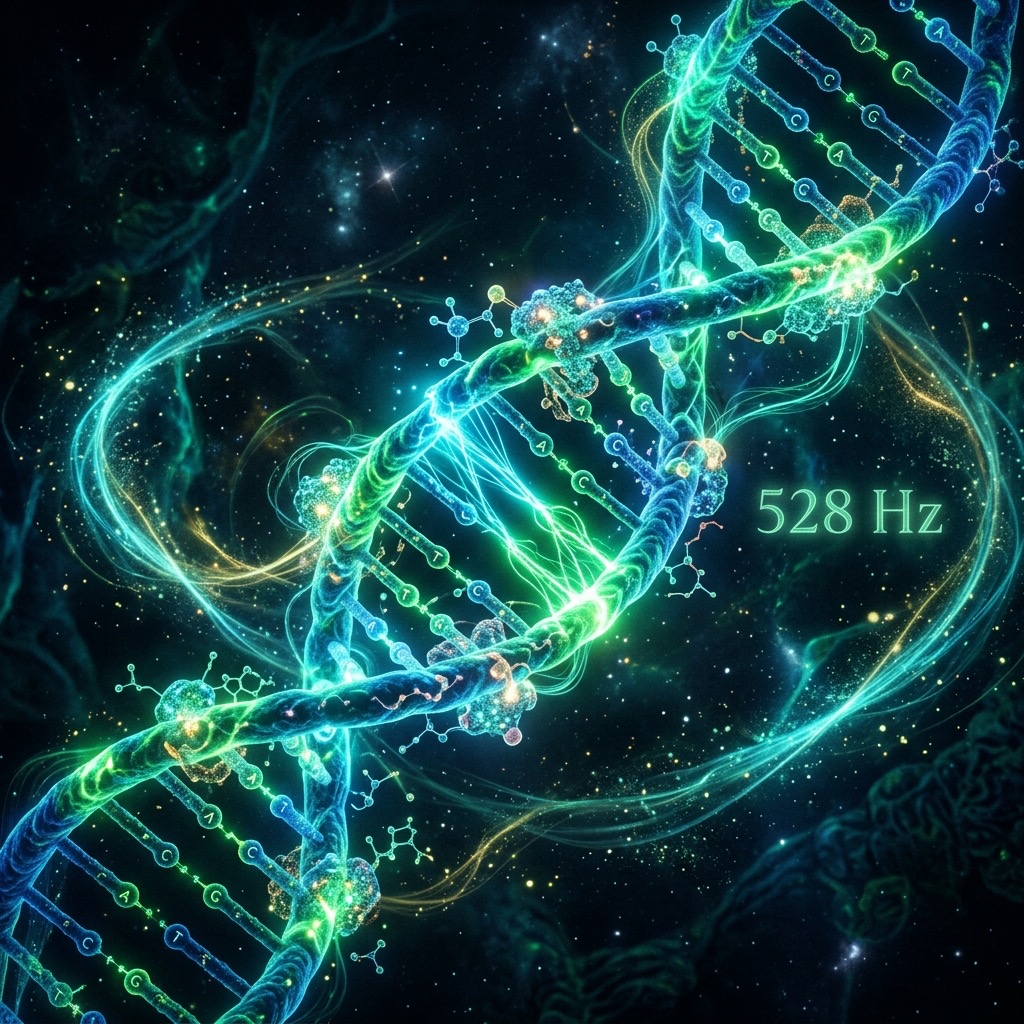
Math scientist Victor Showell describes 528 as fundamental to the ancient Pi, Phi, and the Golden Mean evident throughout natural design. Some researchers and spiritualists suggest that 528 Hz has the potential to repair DNA and bring about transformation and miracles in one's life.
Benefits and Applications
- DNA Repair: While scientifically debated, many believe this frequency helps repair human DNA to its original, perfect state.
- Deep Healing: It is used to increase life energy, clarity of mind, awareness, awakened or activated creativity, and ecstatic states like deep inner peace.
- Meditation: Listening to 528 Hz during meditation can open the heart chakra and promote feelings of love and compassion.
Whether for spiritual practice or relaxation, 528 Hz offers a soothing and uplifting auditory experience.