The 16 Hz Tone Generator: Your Subwoofer's Ultimate Stress Test and the Physics of Felt Sound
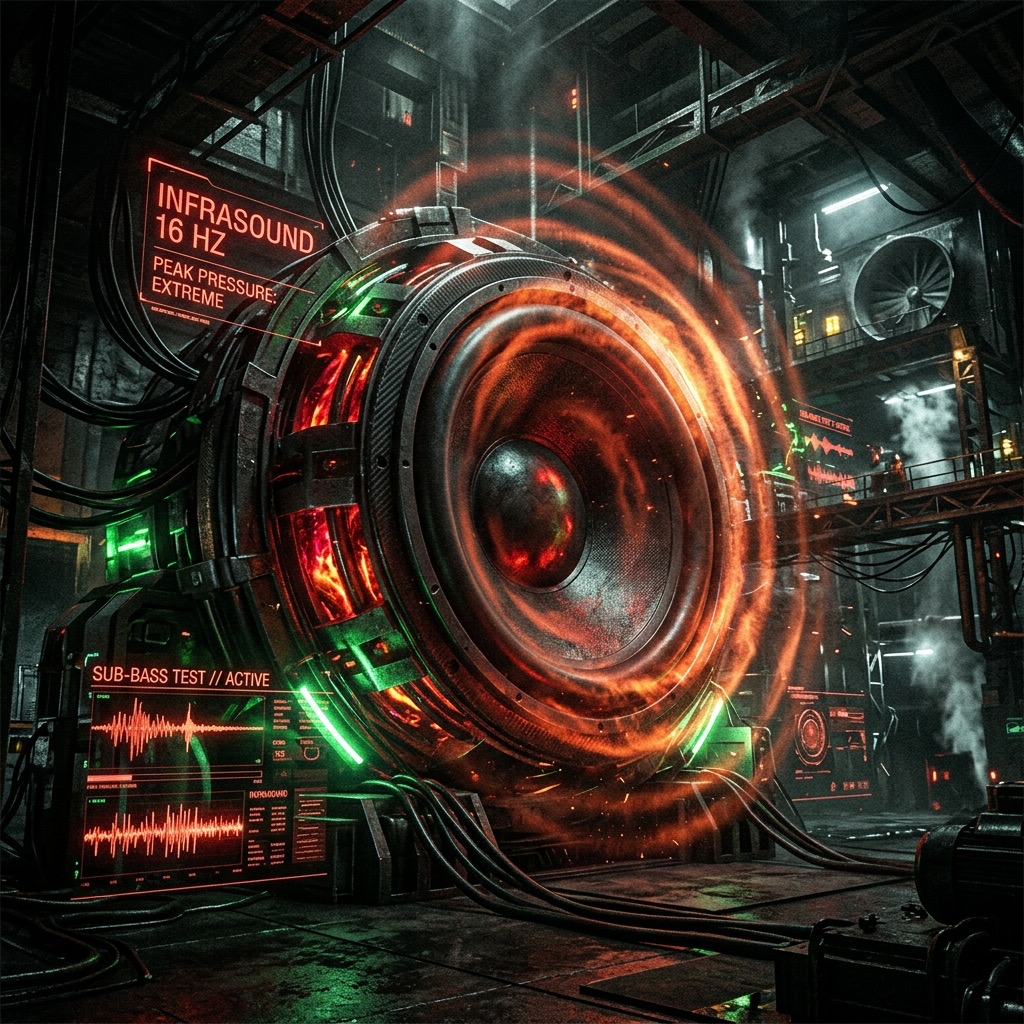
Most people listen to music. A select few *feel* it. If you've landed on this page, you're likely chasing the latter—that visceral, chest-compressing pressure that doesn't just register in your ears, but rattles your sternum and vibrates the floorboards. 16 Hz isn't a sound you hear; it's a physical event. It sits deep in the infrasound category, a full octave below the standard 32 Hz limit of most consumer subwoofers and nearly a full octave below the 20 Hz threshold of human hearing. This generator is not a toy. It is a diagnostic tool, a calibration source, and a gateway to understanding acoustic pressure at its most primal level.
Why 16 Hz? Solving the "I Can't Hear My Subwoofer" Crisis
You didn't search for this frequency because you wanted a pleasant melody. You searched because you suspect your system is lying to you. The specific problem 16 Hz solves is verification of low-end extension. Most audiophiles have a subwoofer that claims a frequency response down to 25 Hz or 20 Hz. But specifications are paper; physics is reality. When you play a 16 Hz tone, you are bypassing the "audible" guesswork and testing the absolute limits of your transducer's excursion and your amplifier's headroom. If your setup can reproduce 16 Hz with authority, it will handle 30 Hz bass lines with effortless grace. This frequency is the ultimate gatekeeper for identifying weak amplifier damping, port noise, and cabinet resonance. If you've ever felt a track "bottom out" or distort on deep synth hits, this tone will expose exactly where your system's mechanical limits begin.
Essential Gear: Why Your Phone Speakers Will Fail Miserably
Let's be brutally clear: you will not hear this tone on your laptop speakers, your earbuds, or even most high-end headphones. To generate 16 Hz, you need to move a massive volume of air. The wavelength at this frequency is roughly 70 feet long—your playback device must physically displace enough air to create that pressure wave. Here is your prerequisite checklist:
- Large Subwoofer (15" or 18" driver minimum): A 10" or 12" subwoofer lacks the cone surface area to produce meaningful SPL at 16 Hz without excessive distortion. You need displacement.
- High-Power Amplifier: You need clean, continuous wattage. A 100-watt amp will clip trying to push 16 Hz. Look for amplifiers rated for high current delivery at low frequencies (200W+ RMS).
- Sealed Enclosure (Preferably): While a ported box can extend low-end response, a sealed enclosure provides the tight damping required to control the massive cone excursion this tone demands. Ported boxes often "chuff" and unload at 16 Hz.
- Physical Connection (Cable): If you are using a phone or laptop, you need a wired connection to your receiver. Bluetooth compresses the audio stream and often rolls off frequencies below 30 Hz due to codec limitations (SBC/AAC). Use a 3.5mm to RCA cable or a USB DAC.
- Room Gain (The Secret Weapon): This is crucial. In a typical car cabin or small room, the interior pressure actually *boosts* frequencies below 30 Hz. If you are in a large, open warehouse, you will lose the bass because there is no boundary reinforcement. Use this generator in a confined space.
Precision Operation: Dialing in the Perfect Infrasonic Pulse
Once your gear is connected, you must operate the generator with surgical precision. Blindly pressing play at full volume is a recipe for blown drivers. Follow this protocol to safely extract the maximum performance from your system.
- Set the Waveform to Sine: This is non-negotiable. A sine wave produces a pure, single frequency. Do not use square or sawtooth waves—those produce harsh harmonics that will destroy tweeters and overheat voice coils. Select the "Sine" option on the generator.
- Zero the Volume: Turn your amplifier's gain knob all the way down, and set the generator's volume slider to 0%.
- Gradual Ramp-Up: Start the tone, then slowly increase the generator volume to about 50%. Listen for any mechanical noise—rattling, buzzing, or chuffing. This is the "torture test" phase. The cone should be moving visibly, in and out, like a slow-motion piston.
- Match the "Feel": Increase the volume to 75%. At this point, you should feel the pressure in your chest and see curtains or loose objects vibrating. The room should feel "heavy." Do not exceed 80% unless you have a high-excursion driver specifically designed for infrasonic playback (like a subwoofer for IMAX home theaters).
- Duration Control: Do not leave this tone on for more than 60 seconds at high volume. Prolonged exposure to high SPL infrasound causes fatigue and can induce nausea. Use it in short bursts for testing.
Maximizing the Rumble: Practical Applications and Expected Results
This frequency is not for relaxation. It is for measurement and physical impact. Here is how to use the 16 Hz output effectively:
- Subwoofer Excursion Testing: Watch the cone. At 16 Hz, you should see the surround flexing deeply. If the cone moves excessively but produces little sound, you are hitting the driver's resonance frequency—this is normal. If you hear a "slapping" sound, you are over-driving it (see warnings below).
- Room Mode Excitation: Use this tone to find the "dead spots" in your listening room. Walk around while the tone plays. In some corners, the bass will be overpowering (pressure zone); in the center of the room, it may almost disappear (null point). This helps you position your subwoofer for optimal bass response.
- Amplifier Thermal Stress Test: A continuous 16 Hz sine wave draws massive current. Run the tone for 30 seconds and then feel your amplifier's heatsink. If it is scorching hot, your amp is not stable at low impedance for this frequency range—a critical insight for preventing future failures.
- Physical Therapy / Deep Relaxation (Advanced): While most use this for tech, some sound therapists use 16 Hz to induce a "vibration bath." Sit in a chair with your back against the subwoofer enclosure. The vibration stimulates the vagus nerve and can promote a deep sense of calm. Note: This is not a medical treatment and should be done with caution.
Hard Limits: When 16 Hz Fails and Why Your Ears Won't Save You
This is where most users get into trouble. The biggest limitation is audibility. If you are listening on headphones, you will hear absolutely nothing—or worse, you will hear the distortion of the headphone driver bottoming out, which sounds like a clicking rattle. Do not turn the volume up trying to "hear" it. You will damage the tiny drivers. Additionally, standard home soundbars have high-pass filters at 40 Hz or 50 Hz to protect their small drivers. They will simply not output this signal. Finally, the warning: Do not play this at high volume for extended periods. Infrasound bypasses the ear's natural protective reflex (the acoustic reflex) which normally dampens loud sounds. You won't feel your ears "ringing," but the pressure wave can cause dizziness, disorientation, and headaches. If you feel your eyes vibrating or your vision blurring, stop immediately—you are at dangerous SPL levels.
16 Hz vs. 20 Hz: The Battle of the Sub-Bass Boundary
Many users wonder why they shouldn't just use 20 Hz instead. The difference is monumental. 20 Hz is the absolute edge of human hearing—most adults over 30 cannot hear it, but it is still considered "audible" in the strictest sense. It is the standard tuning frequency for pipe organs and is often used for cinematic LFE (Low Frequency Effects) in movies. 16 Hz, however, is a full 4 Hz lower—which is nearly a 25% decrease in frequency. This pushes you from "deep bass" into "infrasound" territory. The tactile response is entirely different: at 20 Hz, you feel a "punch"; at 16 Hz, you feel a "pressure" or a "weight." Furthermore, 20 Hz is easily reproducible by a decent 12" subwoofer, while 16 Hz requires a dedicated large driver. If 20 Hz is the threshold of hearing, 16 Hz is the threshold of physical perception—the point where the sound becomes a tangible force rather than an auditory event.
Troubleshooting the Deep End: Why Am I Not Feeling Anything?
Here are the three most common failures when attempting to reproduce this frequency, and their precise fixes.
Issue #1: "I hear a clicking/rattling sound, but no bass."
This is the sound of your driver hitting its mechanical limits (voice coil bottoming out). The fix is not more volume—it's less. Reduce the generator volume to 50% and check if the clicking stops. If it does, your subwoofer cannot handle the excursion at higher volumes. You need a subwoofer with a longer x-max (linear excursion) rating. Alternatively, your enclosure port is too small. Seal the port temporarily to increase damping.
Issue #2: "The tone plays, but my subwoofer cone isn't moving."
This indicates your amplifier or receiver has a subsonic filter (also called an "infrasonic filter") enabled. This filter is designed to remove frequencies below 20 Hz to protect speakers. Go into your receiver's settings and disable the subsonic filter or set it to 10 Hz or "Off." If you are using a laptop headphone jack, the sound card may also have a high-pass filter—use an external USB audio interface to bypass the internal sound card.
Issue #3: "I can feel the bass in my chest, but my ears hear nothing. Is it working?"
Yes, it is working perfectly. You are experiencing infrasound. Your ears are not designed to transduce 16 Hz into a "tone." You are feeling the pressure wave as tactile sensation. To verify the frequency is correct, place your hand on the subwoofer cone. You should feel a slow, rhythmic pulse—about 16 pulses per second. If you feel that, the generator is functioning correctly. Do not expect to hear a pitch; expect to feel a rumble.
16 Hz Subwoofer and Bass Test Tone
A 16 Hz test tone sits in the sub-bass range, the deepest tier of bass extending below 40 Hz. It is felt as physical pressure and vibration rather than heard as a distinct pitch. Use this tone to evaluate the low-frequency performance of your subwoofer, woofer, or bass-capable speakers.
What 16 Hz Reveals About Your Audio System
- Subwoofer Extension: Tests how deep your subwoofer reaches without distortion or roll-off at 16 Hz.
- Room Acoustics: Reveals standing waves, bass buildup, and room modes that affect low-frequency performance.
- Crossover Accuracy: Helps verify your subwoofer crossover is set correctly relative to your main speakers.
- Amplifier Headroom: Tests whether your amplifier delivers clean power at 16 Hz under load.
How to Run This Bass Test
Play the 16 Hz tone at moderate volume. Listen for distortion, rattle, port noise, or uneven output. Adjust subwoofer level, crossover frequency, and room positioning accordingly. For precision, pair with an SPL meter or room correction software.
Play 16 Hz Bass Test Tone Free Online
Generate a pure 16 Hz sine wave instantly in your browser. No software needed. Use it anytime to quickly assess your bass performance.