The 35 Hz Tone Generator: Your Subwoofer's Truth Serum
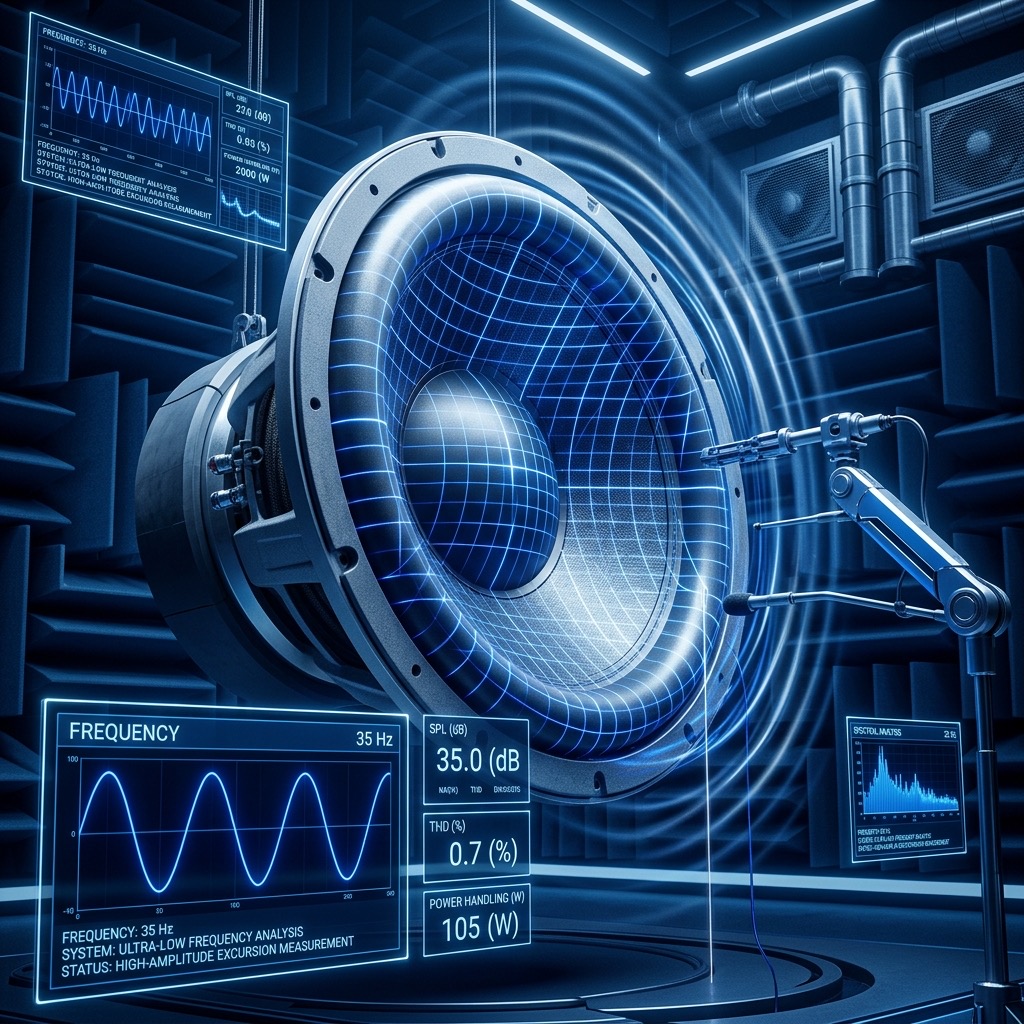
Let's be brutally honest for a second. Most consumer audio gear—and even a fair amount of "pro" equipment—is a liar. It pretends to deliver deep bass, but when you strip away the marketing hype, it's just producing a muddy, thumpy approximation of what the recording actually contains. 35 Hz is where that deception dies. This isn't a frequency you merely hear; it's one you feel in your chest cavity and the soles of your feet. If you've landed on this page, you're not looking for a pleasant ambient hum. You're looking for a diagnostic tool to expose the truth about your sound system's low-end capability, or you're a producer checking whether that kick drum sub-layer is actually translating. This tone is the benchmark for sub-bass integrity.
Why 35 Hz Specifically? The "Crossover" Conundrum
Why not 30 Hz? Why not 40 Hz? Because 35 Hz sits in the "no man's land" of bass response. Most standard home theater subwoofers are tuned to roll off somewhere between 30 and 40 Hz to protect the driver from over-excursion. This means 35 Hz is often the very edge of what a mediocre sub can reproduce. It's the frequency where a ported enclosure might "chuff" (that annoying air noise) and where a sealed subwoofer will either dig deep with authority or give up entirely. If you're searching for this specific tone, you likely suspect your system is weak in this region, or you're trying to tune a room mode that's canceling out this exact wavelength. This is the frequency that separates a "bass-boosted" speaker from a true subwoofer.
Before You Press Play: Equipment Prerequisites
Do not—I repeat, do not—try to evaluate 35 Hz using your laptop's built-in speakers or a pair of standard earbuds. You will hear nothing but a faint clicking or a weak buzz, and you'll incorrectly assume the generator is broken. To properly utilize this tool, you need equipment that can physically move air at this slow rate.
- The Gold Standard: A dedicated subwoofer (10" or larger driver) in a properly sized enclosure, connected via an AV receiver or amplifier with a crossover set to at least 80 Hz.
- The Headphone Route: You can test this with high-end, open-back planar magnetic headphones (like Audeze or Hifiman) or premium dynamic cans (like the Sennheiser HD 800 series). These have the excursion capability to produce a whisper of 35 Hz, but they will not produce the physical "punch" you get from a sub.
- The "Feel" Check: Place a glass of water on a hard surface next to the subwoofer. If the water ripples visibly at moderate volume, you have true sub-bass output. If the glass vibrates but the water surface is still, you're hearing harmonic distortion, not fundamental 35 Hz output.
Operating the Generator: A Step-by-Step Calibration
This isn't a "set it and forget it" tool. You need to be deliberate. Follow this sequence to avoid damaging your equipment and to get an accurate read on your system's performance.
- Set the Waveform: Start with the Sine Wave setting. Do not use a square wave for testing. A square wave at 35 Hz contains high-order harmonics (70 Hz, 105 Hz, 140 Hz) that will mask the true sub-bass performance. The sine wave is pure, singular, and unforgiving.
- Zero the Volume: Turn your amplifier or receiver's volume knob all the way down. Do not rely on the digital slider on this website.
- Initiate the Tone: Press play on the generator. You should hear nothing yet.
- Slowly Raise the Gain: Increase the volume on your physical amplifier in small increments (1-2 dB at a time). Listen for the following:
- Distortion: A "flapping" or "clacking" sound indicates the driver is bottoming out—turn it down immediately.
- Port Noise: A "whistling" or "chuffing" sound from the bass reflex port means the air velocity is too high for the enclosure design.
- Audible Tone: You should hear a deep, smooth, organ-like pitch. If it sounds like a buzz, your sub's crossover is set too high.
- Walk the Room: Keep the tone playing and walk around the room. You will find "dead zones" where the volume drops dramatically. This is a standing wave null—a room acoustics issue, not a speaker issue.
Practical Applications: Tuning, Testing, and Psychoacoustics
Beyond just "testing" your gear, this frequency has specific, professional-grade uses. It's not just for hifi nerds; it's for anyone who needs to understand the physics of low-frequency energy in a space.
- Subwoofer Phase Alignment: If you have two subs, play this tone and invert the phase on one. The bass should get louder in one position and quieter in the other. Adjust the physical placement until you find the position where the bass is most uniform across the listening position.
- Room Mode Excitation: 35 Hz has a wavelength of roughly 32 feet. In a typical living room, this will create massive pressure zones. Use this tone to identify where your room resonates most (usually corners) and place bass traps there.
- Sound Therapy (Low-Pressure Massage): At a low volume (under 70 dB), this frequency can induce a state of physical relaxation. It's not about hearing; it's about the vestibular system responding to the pressure waves. Use it for a "body scan" meditation—focus on where you feel the vibration (chest, gut, thighs) and breathe into that space.
- Mixing Reference: For music producers, this is the "tuning" frequency for many modern sub-bass lines (D#0/D#1 is 38.89 Hz, but 35 Hz is close to a low F). If your track's sub-bass is at 35 Hz and you can't hear it clearly, you need to add harmonic distortion (saturation) to make it audible on smaller speakers.
Critical Limitations: When 35 Hz Fails You
This tone is a precision instrument, and like any precision instrument, it has a narrow field of use. Don't blame the generator when these scenarios occur.
- Small Bluetooth Speakers: A speaker with a 2-inch driver physically cannot reproduce a 32-foot wavelength. You will get a "thumpy" mid-bass harmonic (around 70-100 Hz) that sounds vaguely like a heartbeat, but it is not 35 Hz. You are hearing distortion.
- Hearing Threshold: At low volumes, many adults over 30 simply cannot perceive 35 Hz as a "tone." It may feel like pressure in the ears or a subtle flutter. If you don't "hear" it, turn it up slightly—but beware of the next point.
- Loudness Danger: This frequency can cause physical nausea and dizziness at high SPLs (above 100 dB). It vibrates your eyeballs and inner ear fluid. Do not crank this to maximum volume to "feel" it. Your body will react negatively.
35 Hz vs. 40 Hz: The Audible Divide
The jump from 35 Hz to 40 Hz might seem trivial, but acoustically, it's a chasm. 40 Hz (low E on a bass guitar) is often the cutoff for "mid-bass" and is much easier for smaller speakers to fake. 40 Hz has a wavelength of about 28 feet, making it easier to reproduce in a car cabin. When you switch from 40 Hz down to 35 Hz, you lose the "pitch" sensation and gain a pure "pressure" sensation. If your system plays 40 Hz loudly but 35 Hz is almost silent, you have a subwoofer with a high-tuned port or a sealed box with insufficient amplifier headroom. A good system should only drop by about 3 dB between these two frequencies; if it drops by 10 dB or more, you have a fundamental design flaw.
Troubleshooting: Why Can't I Hear/Feel It?
Here are the three most common issues I see when users fire up this specific frequency for the first time.
Issue 1: "I hear a clicking or buzzing, not a tone."
This is almost always a crossover setting problem. If your receiver is set to "Small" speakers with a crossover at 120 Hz, the sub is getting the signal, but the main speakers are also trying to play it. The "clicking" is the mid-woofer trying to move 30 feet of air. Fix: Set your speakers to "Large" or "Full Range" and set the subwoofer crossover to 80 Hz or lower (if possible). Ensure the sub is set to "LFE" not "LFE+Main" to avoid double-bass.
Issue 2: "I have a big sub, but the tone is very quiet."
You are likely sitting in a room null. A 35 Hz wave reflects off your walls and cancels itself out at your listening position. Fix: Move your head or the subwoofer by 2-3 feet. Even a small movement can shift you out of the destructive interference zone. Alternatively, place the sub in a corner to reinforce the boundary loading.
Issue 3: "The sound is there, but it's not 'boomy' or 'loud'."
That is a good thing! 35 Hz should feel like a smooth, constant pressure, not a "boom." If it sounds "boomy," you are likely hearing the second harmonic (70 Hz) which is being produced by the subwoofer's distortion, not the fundamental frequency. Fix: Turn the volume down. The "boom" you crave is actually a distortion artifact. A clean 35 Hz tone is almost eerily quiet to the ears but massive in pressure.
35 Hz Subwoofer and Bass Test Tone
A 35 Hz test tone sits in the sub-bass range, the deepest tier of bass extending below 40 Hz. It is felt as physical pressure and vibration rather than heard as a distinct pitch. Use this tone to evaluate the low-frequency performance of your subwoofer, woofer, or bass-capable speakers.
What 35 Hz Reveals About Your Audio System
- Subwoofer Extension: Tests how deep your subwoofer reaches without distortion or roll-off at 35 Hz.
- Room Acoustics: Reveals standing waves, bass buildup, and room modes that affect low-frequency performance.
- Crossover Accuracy: Helps verify your subwoofer crossover is set correctly relative to your main speakers.
- Amplifier Headroom: Tests whether your amplifier delivers clean power at 35 Hz under load.
How to Run This Bass Test
Play the 35 Hz tone at moderate volume. Listen for distortion, rattle, port noise, or uneven output. Adjust subwoofer level, crossover frequency, and room positioning accordingly. For precision, pair with an SPL meter or room correction software.
Play 35 Hz Bass Test Tone Free Online
Generate a pure 35 Hz sine wave instantly in your browser. No software needed. Use it anytime to quickly assess your bass performance.