The 45 Hz Tone Generator: Your Subwoofer's Truth Serum
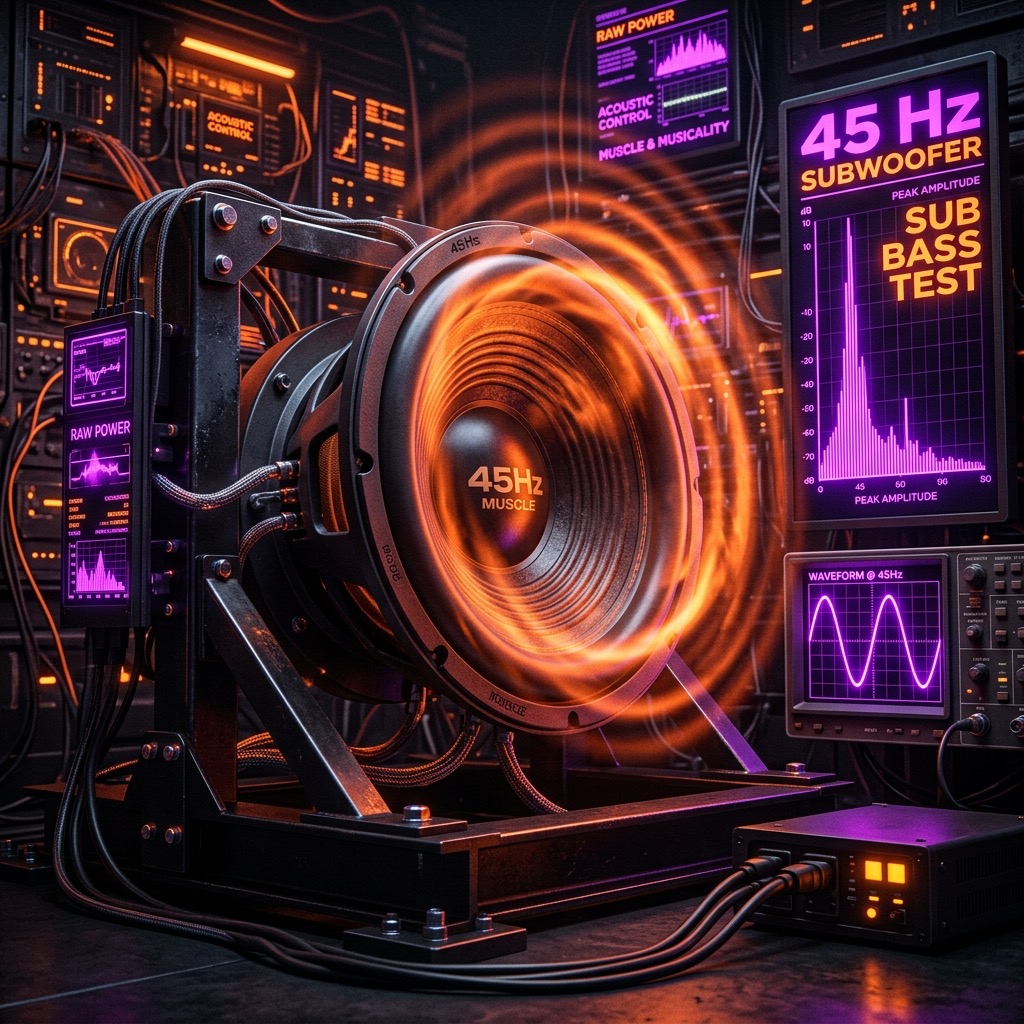
Let's cut through the noise. If you've landed on this page, you're not casually browsing. You're chasing a specific, physical feeling—the kind of pressure that doesn't just hit your ears but moves the air in your chest. You're here because 45 Hz sits in a fascinating, powerful sweet spot. It's not the sub-sonic rumble of an earthquake (that's 20 Hz territory), and it's not the punchy thump of a kick drum (usually 60–80 Hz). 45 Hz is where musicality meets raw physicality. This is the frequency that separates a decent sound system from a truly visceral one. Let's get into why this specific tone is your ultimate diagnostic tool.
Why 45 Hz? The "Mid-Bass Muscle" Problem
Most consumer speakers—even expensive soundbars—can fake their way through higher bass. But 45 Hz is a filter. This frequency is the critical threshold for subwoofer integration. It's the fundamental frequency of a low piano note (A1 on a standard piano is 55 Hz, but the lower octave dips right into our range), the deep thrum of a synth pad, and the growl of a contrabass. When a system struggles at 45 Hz, you hear it as a "hollow" mix—the bass seems to disappear or becomes muddy and indistinct.
Searching for this tone means you're testing extension and control. You want to know if your driver can reproduce the note cleanly without port noise or distortion. This is the frequency that reveals if your subwoofer is a one-note wonder or a true instrument. It's the "muscle tone" of your low-end—not just raw power, but the ability to sustain and resolve a note with authority.
Gear Up: What You Need for a True 45 Hz Experience
Honesty time: your laptop's internal speakers are useless here. They physically cannot move enough air. To test 45 Hz properly, you need a system that can breathe.
- The Gold Standard: A dedicated subwoofer (8" or larger) in a sealed or ported enclosure, paired with main speakers set to "small" with a crossover around 80 Hz. This sends the 45 Hz signal exclusively to the sub, which is what you want.
- The Headphone Caveat: Good over-ear headphones can reproduce 45 Hz, but you'll lose the physical sensation. You'll hear the pitch, but not feel the pressure. In-ear monitors (IEMs) are often worse at this frequency due to their tiny drivers.
- The Room: Placement matters. Corners reinforce bass. If you're testing for accuracy, place the sub away from walls. If you're testing for maximum output, the corner is your friend.
- Amplifier Health: Make sure your amp has enough headroom. Clipping at 45 Hz sounds like a harsh, rattling buzz—that's distortion, not bass.
The Operating Procedure: Dialing In Your 45 Hz Tone
Using the generator is simple, but doing it right takes a bit of finesse. Follow this sequence to avoid blowing a driver or just wasting time.
- Start at Zero: Turn your amplifier volume all the way down before pressing play. This is non-negotiable.
- Select Your Waveform: For testing, use a sine wave. It's a pure, single frequency with no harmonics. This is your "clean" test tone. A square wave at 45 Hz is a torture test—it contains odd-order harmonics that will stress tweeters and reveal harshness, but it's not for evaluating bass extension.
- Press Play, Then Raise Volume: Slowly increase the volume. You're looking for two things: (a) a smooth, even tone, and (b) a lack of "chuffing" or port noise.
- Walk the Room: Don't sit in the "sweet spot" only. Move around. At 45 Hz, the wavelength is about 25 feet long. You will have standing waves—some spots will be loud, some will be dead. This is physics, not a broken speaker.
- Duration: Do not play this tone at high volume for more than 30 seconds at a time. It's a test, not a soundtrack. Prolonged exposure to a single frequency can cause listening fatigue or, worse, thermal damage to your voice coil.
Real-World Applications: Beyond the "Test"
This tone is not just for nerdy troubleshooting. It's a creative and calibration tool.
- Subwoofer Phase Alignment: Play 45 Hz and have a friend slowly flip the phase switch on your sub (0° to 180°). The correct setting is the one where the bass sounds louder at your listening position, not boomy or weak.
- Room Mode Mapping: Use this tone to identify problematic bass nodes in your room. If you find a "dead zone" where the tone vanishes, you know you need bass traps or a different seating position.
- Sound System "Tuning" for DJs: Before a set, a quick 45 Hz sweep tells you if the venue's system can handle low-end pressure without clipping. It's your pre-flight check.
- Meditative Focus: Some listeners find the sustained, low vibration of 45 Hz grounding. It's a "brown note" adjacent frequency—more about physical release than audible melody. Use it at low volume for a body-focused meditation.
Critical Limitations: Why This Tone Fails (And When to Stop)
This is where most people get frustrated. You need to know the physics of your gear.
- Phone & Laptop Speakers: They will distort or simply produce nothing. If you hear a buzzing rattle, that's the speaker cone reaching its mechanical limit. Stop immediately. You are damaging the driver.
- Small Bookshelf Speakers: Even good ones (5" woofers) will struggle to produce 45 Hz at any meaningful volume. They'll drop off steeply below 60 Hz. You'll hear a faint "tick" but no bass.
- Hearing Limitations: Some adults have reduced sensitivity below 50 Hz. If you can't "hear" it, check if you can feel the pressure on your eardrums or in your chest. If not, your system isn't reproducing it.
- Volume Danger: 45 Hz is low, but it's not "safe." At high volumes, it can cause inner ear fluid displacement and dizziness. It can also cause your windows to rattle, which is annoying, but not dangerous to you—just your neighbors.
The Context: 45 Hz vs. 50 Hz vs. 40 Hz
You might be wondering why you shouldn't just use 50 Hz, which is a common bass test tone. Here's the breakdown:
- 50 Hz: This is the "standard" bass frequency. Most cheap systems can fake this. It sounds punchy and present. If 50 Hz sounds fine but 45 Hz sounds weak, your sub's crossover is set too high or the driver has poor excursion.
- 40 Hz: This is deeper, more sub-sonic. It's the frequency of the lowest organ pipes. If your system plays 45 Hz cleanly but 40 Hz is muddy, you have a port tuning issue (ports are usually tuned to ~35-40 Hz).
- 45 Hz (The Sweet Spot): It's high enough to be "musical" and low enough to reveal the quality of your sub's motor structure. It's the best single frequency for a quick, reliable health check of your low-end. It tells you about control—does the cone stop when the note stops?
Troubleshooting: Why Your 45 Hz Test Sounds Bad
Here are the top three issues I hear from users, and the fixes.
Issue 1: The tone is "warbling" or "pulsing."
This is almost always room acoustics. The 25-foot wavelength is bouncing between parallel walls, creating constructive and destructive interference. Fix: Move your head two feet in any direction. If the warble changes, it's the room. Add soft furniture or a thick rug to break up the reflections.
Issue 2: There's a nasty "buzz" or "rattle" that isn't the bass.
This is mechanical. It's not your subwoofer—it's something else in the room vibrating sympathetically. Fix: Walk around and find the culprit. It's usually a loose light fixture, a picture frame against the wall, or a vent cover. Tighten it or dampen it with a piece of blu-tack.
Issue 3: It sounds fine at low volume, but distorts when turned up.
This is the classic amplifier clipping or subwoofer bottoming out. You're asking for more excursion than the driver can physically handle. Fix: Turn it down. If you need more volume, you need a larger subwoofer, not more amplifier gain. If the cone is visibly "flapping" with a clacking sound, you've hit the mechanical limit—back off immediately to prevent coil damage.
45 Hz Subwoofer and Bass Test Tone
A 45 Hz test tone sits in the bass range between 40-80 Hz, where kick drums and bass guitar fundamentals live. It is heard as deep, warm bass with strong physical impact. Use this tone to evaluate the low-frequency performance of your subwoofer, woofer, or bass-capable speakers.
What 45 Hz Reveals About Your Audio System
- Subwoofer Extension: Tests how deep your subwoofer reaches without distortion or roll-off at 45 Hz.
- Room Acoustics: Reveals standing waves, bass buildup, and room modes that affect low-frequency performance.
- Crossover Accuracy: Helps verify your subwoofer crossover is set correctly relative to your main speakers.
- Amplifier Headroom: Tests whether your amplifier delivers clean power at 45 Hz under load.
How to Run This Bass Test
Play the 45 Hz tone at moderate volume. Listen for distortion, rattle, port noise, or uneven output. Adjust subwoofer level, crossover frequency, and room positioning accordingly. For precision, pair with an SPL meter or room correction software.
Play 45 Hz Bass Test Tone Free Online
Generate a pure 45 Hz sine wave instantly in your browser. No software needed. Use it anytime to quickly assess your bass performance.